
How To Calculate Property Tax: What Homeowners Should Know About How to Estimate Property Taxes

Most people know that homeownership requires coughing up copious amounts of money. There’s your mortgage, of course, but the costs hardly end there. What about how to calculate property taxes and save for them?

If you already own a home, you can look at how your tax is calculated on the most current property tax statement. If you’re considering buying a home, look on the real estate listing for assessment and tax information, or go to the county website to find out the annual property tax.

Be aware that property taxes can change. The assessed value of your house can go up or down, depending on the local real estate market. Your assessment can also rise or fall depending on changes you make to your house—for example, if you make additions to your property. And the tax rate can change depending on your local government.

Even though the government sends you a tax bill every year and tells you how much you owe in property taxes, it’s important to know how that tax is calculated. Here’s what to know about how to calculate property taxes.

Property tax calculator: How to calculate property taxes

There are a number of factors that come into play when calculating property taxes, from your property’s assessed value to the mill levy (tax rate) in your area. Here’s how to calculate property tax so you don’t end up blindsided by this hefty homeowner expense.

What is a home’s fair market value?

The market value of a home is basically the amount a knowledgeable buyer would pay a knowledgeable seller for a property, assuming an arm’s-length transaction and no pressure on either party to buy or sell. When a property sells to an unrelated party, the sales price is generally assumed to be the fair value of the property.

What is a home’s assessed value?

One factor that affects your property taxes is how much your property is worth. You probably have a good understanding of your home’s market value—the amount of money a buyer would (hopefully) pay for your place. (You could also enter your address in a home value estimator to get a ballpark figure.)

Still, tax municipalities use a slightly different number; it’s called your home’s assessed value.

Tax assessors can calculate a home’s current assessed value as often as once per year. They also may adjust information when a property is sold, bought, built, or renovated, by examining the permits and paperwork filed with the local municipality.

They’ll look at basic features of your home (like the acreage, square footage, and number of bedrooms and bathrooms), the purchase price when it changes hands, and comparisons with similar properties nearby. Size alone is not what determines taxes. For example, property tax is not always lower for a condo than a house.

Sometimes a home’s assessed value will be strikingly similar to its fair market value—but that’s not always the case, particularly in heated markets. In general, you can expect your home’s assessed value to amount to about 80% to 90% of its market value. You can check your local assessor or municipality’s website, or call the tax office for a more exact figure for your home. You can also search by state, county, and ZIP code on publicrecords.netronline.com.

If you believe the assessor has placed too high a value on your home, you can challenge the calculation of your home’s value for tax purposes. You don’t need to hire someone to help you reduce your property tax bill. As a homeowner, you may be able to show how you determined that your assessed value is out of line.

What is taxable value?

The taxable value of your house is the value of the property according to your assessment, minus any adjustments such as exemption amounts.

What’s a mill levy?

In addition to knowing your home’s assessed value, you will need to know another number, known as a mill levy. That’s the tax assessment rate for real estate in your area. The tax rate varies greatly based on the public amenities offered and revenue required by local government.

If you have a public school, police force, full-time fire department, desirable school districts, and plenty of playgrounds and parks, your property tax rates will be higher than a town without them. (Hey, you get what you’re taxed for!)

Your area’s property tax levy can be found on your local tax assessor or municipality website, and it’s typically represented as a percentage—like 4%. To estimate your real estate taxes, you merely multiply your home’s assessed value by the levy. So if your home is worth $200,000 and your property tax rate is 4%, you’ll pay about $8,000 in taxes per year.

Where to find property taxes, plus how to calculate property tax

Thankfully, in many cases, you may not have to calculate your own property taxes. You can often find the exact amount (or a ballpark figure) you’ll pay on listings at realtor.com®, or else you can enter a home’s location and price into an online home affordability calculator, which will not only estimate your yearly taxes but also how much you can anticipate paying for your mortgage, home insurance, and other expenses.

Source: Realtor.com

ARE YOU READY TO CLOSE YOUR DEALS?

LET US HELP YOU CLOSE IT BY FILLING OUT OUR FORM OR
GIVING US A CALL AT

(626) 796-1680

CALL IT NOW!

Seller’s Market, Buyer’s Market, ‘Nobody’s Market’? The Weird State of Housing Right Now

Today’s housing market has everyone wondering: Is it still a seller’s market, or has the power dynamic finally shifted in favor of buyers?

Try neither.

Uncertainty about the future of inflation, the economy, mortgage rates, and more have seized up the market—and wrenched power away from buyers and sellers alike.

“Today, real estate is ‘nobody’s market,'” notes Realtor.com® Chief Economist Danielle Hale in her analysis of housing data for the week ending Feb. 4. “The number of homeowners deciding to sell continues to lag, but inventory and time on market continue to climb, reflecting still-hesitant buyers.”

We’ll break down what the latest real estate statistics mean for homebuyers and sellers in this latest installment of “How’s the Housing Market This Week?


Affordability on ‘the brink’

Although mortgage rates for a 30-year fixed-rate home loan have fallen from October’s 20-year high of 7.08%, they’re still high enough to leave a whole lot of buyers leery about closing the deal.

For the week ending Feb. 9, interest rates continued along their recent jagged path, ticking up to 6.12%, according to Freddie Mac.

Meanwhile, median listing prices, which hovered around $400,000 in January, are still higher than they were last year. For the week ending Feb. 4, prices were up 7.7% compared with this same week a year earlier.

“With high home prices and mortgage rates pushing affordability to the brink for many potential buyers, market activity and pricing will be more dependent than usual on the trajectory for mortgage rates,” says Hale.

More homes are sitting on the market

With home prices and mortgage rates still uncomfortably high, buyers just aren’t biting, leading to a glut of real estate listings gathering dust. For the week ending Feb. 4, home inventory shot up by 70% over levels seen this same week a year earlier.

As a result, many homeowners simply do not want to sell their homes as of late. New listings were down by 11% from one year ago for the week ending Feb. 4.

That marks 31 weeks that fewer sellers have put their homes on the market compared with last year, and for good reason: Sellers might not only struggle to sell, but if they succeed, many might have to face the same steep home prices and mortgage rates as other buyers, making it a lose-lose scenario all round.

“High costs and mortgage rates can significantly up the ante for homeowners hoping to trade up and remain in their current area,” explains Hale. Many are deciding to just stay put.

Plus, this continuing lull in new listings means homebuyers might not be all that excited by the idea of sifting through stale, steeply priced properties.

“With new listings declining, the growing number of homes for sale reflects still-low buyer interest amid high costs,” adds Hale.

Some good news for home shoppers

In January, homes lingered on the market for 75 days. And for the week ending Feb. 4, listings sat for 19 days longer compared with this time last year. Overall, the housing market is currently experiencing a 28-week trend of homes lingering on the market for longer periods than they did a year earlier.

But this presents a unique opportunity for buyers willing to comb through old listings for bargains.

“January data also reveals a significant increase in the share of homes for sale with a price reduction, more than double compared to the same period last year,” says Hale.

Slow movements in the market signal hope

Despite the morass many buyers and sellers find themselves in, there is evidence the market is trudging forward.

“Looking ahead, in addition to a slowing decline in existing-home sales in December, both new-home sales and pending home sales saw an uptick,” says Hale. “These indicators, which track early stages of transactions, jibe with the sentiment data that shows a very modest improvement.”

Buyers now have more time to carefully consider their options. And when they find a home, they can try striking a deal.

Sellers can take heart that despite inventory surging, January data shows that most housing markets have fewer homes for sale than were typically available pre-pandemic. If a seller has a good home that’s priced right, it will likely sell quickly.

“Longer time on market overall doesn’t necessarily mean longer time on market for the most desirable homes,” Hale explains.

So perhaps both buyers and sellers might shake hands on more deals soon enough.

Source: Realtor.com

HAVE ANY SCENARIOS YOU WANT US TO LOOK AT?


SIMPLY FILL OUT OUR FORM OR
GIVE US A CALL AT
(626) 796-1680


TO GET STARTED!

What Is a Multifamily Home? Owning Many Units Can Lead to a Steady Cash Flow

Unlike single-family homes, multifamily homes are dwellings with more than one unit that each have their own bathroom and kitchen. Interested in how this type of property could pay off for you? Read on for our breakdown of multifamily homes.

Multifamily home characteristics

The most attractive part of investing in and renting out a multifamily home is the steady revenue stream you can get from collecting rent. Most people living in a multifamily home are looking to offset mortgage payments by using the income from renting out the other unit, says Lee Kiser, principal and managing broker at Kiser Group in Chicago.

There are also tax advantages to buying a multifamily home. You can write off expenses related to your rental income and deduct the prorated portion of the mortgage interest.

Also, an owner-occupied property may be a wise choice for homeowners living with members of their family, such as their adult children or elderly parents. They can live in one of the units for a period of time and not have to fork over all their savings on rent or a mortgage.

How to find multifamily homes

Searching for available multifamily homes is simple. You can find multifamily homes through a search tool like realtor.com and filtering by property type. That’s a good place to start to see what’s available in the town you’d like to buy in. Additionally, Kiser suggests checking with commercial brokers. They offer more multifamily investment possibilities.

If you think you could benefit from an expert’s opinion, Carol Greeley, a real estate agent in the greater Boston area, suggests you find a buyer’s agent.

A buyer’s agent helps guide you through the search and helps you round out your house wish list. They’ll also advise you on how to submit an acceptable offer. And since the seller pays the real estate agents’ commission fees, it’s virtually free for you.

Multifamily home as an investment

Just like any new home, a multifamily home may be move-in ready, or it might be a serious fixer-upper. Before buying a multifamily home, you should perform due diligence and assess just how much money you’ll need to put into sprucing up the units. Make sure the home has a sturdy roof and structure, and all major systems like plumbing and HVAC are in working condition.

Susan Haas, a real estate agent at Joyner Fine Properties in Richmond, VA, suggests getting quotes from contractors on any work that’s needed before making an offer on a home.

If anything is out of order, you’re looking at a project that will cost upward of a few thousand dollars. For example, a new roof for a standard ranch-style house will cost around $5,000 to $8,000 on the low end, according to roofingcalc.com.

Also, remember that you’ll likely need to perform work on the units before opening the doors for prospective tenants. A newly renovated home will attract more tenants and allow you to charge higher rent in the long run.

How much for regular upkeep?

The initial renovation costs are just the beginning; once you have tenants you’ll have to deal with maintaining multiple kitchen and bathrooms.

Kiser says a good rule of thumb is to expect $300 to $500 worth of annual home improvements for each unit. So, a multifamily home with three units will cost between $900 and $1,500 annually for regular home improvement tasks.

Of course, being handy can save money. Landlords of smaller multifamily homes may opt to perform basic maintenance tasks themselves instead of hiring someone like a plumber or painter. Some renters are cool with that, but others may prefer you hire a professional to take care of home projects.

Source: Realtor.com


Do you HAVE ANY SCENARIOS
YOU WANT US TO LOOK AT?

EITHER FILL OUT OUR
FORM OR GIVE US A CALL!

(626) 796-1680!

Housing Market Update: Sales Are Slow To Kick Off New Year, But More Buyers Start Searching

Homes are selling at their slowest pace since the housing market nearly ground to a halt at the beginning of the pandemic. The typical home that sold during the four weeks ending January 8 was on the market for 44 days, the longest timespan since April 2020, contributing to the biggest annual inventory increase on record. Pending home sales dropped 32% year over year to their lowest level on record and mortgage-purchase applications dropped to their lowest level since 2014. 

High mortgage rates and extreme winter weather at the start of the year deterred would-be homebuyers, exacerbating the typically holiday slowdown. But there are signs that early-stage demand is up. Redfin’s Homebuyer Demand Index–a measure of tour requests and other buying services from Redfin agents–posted a 6% increase over the last month, and Google searches for “homes for sale” are on the rise. Some buyers are likely coming in from the sidelines because mortgage rates have dropped to 6.33% from their November peak of over 7%, saving the typical U.S. homebuyer roughly $250 on monthly housing payments. 

Buyers may also be encouraged by signs of improvement in the economy, with inflation easing in December for the sixth month in a row as wage growth softens.  

“We’re entering 2023 with positive economic news: The latest consumer price index report confirms that the worst of inflation is behind us. That means the Fed is likely to continue easing its interest-rate increases, which should cause mortgage rates to continue gradually declining.  This could bring back some homebuyers in the coming months,” said Redfin Deputy Chief Economist Taylor Marr. “We’ve already seen an uptick in people initiating home searches. Although those house hunters haven’t yet turned into buyers, they may soon given that monthly mortgage payments are notably down from their peak and the latest inflation and employment data lower the chances of a recession.” 

Home prices fell from a year earlier in 20 of the 50 most populous U.S. metros

The typical U.S. home sold for $351,250 during the four weeks ending January 8. That’s up 0.8% from a year earlier, but down about 10% from the June peak. 

Home-sale prices fell year over year in 20 of the 50 most populous U.S. metros. By comparison, 11 metros saw price declines a month earlier. 

Prices fell 10.6% year over year in San Francisco, 5% in Seattle, 4.9% in San Jose, 4% in Austin, 3.8% in Detroit, 3.7% in Phoenix, 3.4% in Oakland, CA, 3% in Boston, 3% in Los Angeles, 3% in Sacramento, 2.6% in San Diego and 2.5% in Chicago. They fell 2% or less in Portland, OR, Anaheim, CA, Portland, OR, Riverside, CA, Newark, NJ, New York, Pittsburgh, Las Vegas and Washington, D.C.

This marks the first time Las Vegas prices have dropped year over year since at least 2015. It’s the biggest year-over-year price drop in San Francisco, Seattle, Phoenix, Chicago, Boston, Portland and San Diego since at least 2015.

Leading indicators of homebuying activity:

  • For the week ending January 12, 30-year mortgage rates declined from the week before to 6.33%. The daily average was 6.15% on January 11.

  • Mortgage-purchase applications during the week ending January 6 declined 1% from a week earlier, seasonally adjusted, hitting their lowest level since 2014. Purchase applications were down 44% from a year earlier. 

  • The seasonally adjusted Redfin Homebuyer Demand Index–a measure of requests for home tours and other homebuying services from Redfin agents–was essentially flat from a week earlier and up 6% from a month earlier during the four weeks ending January 8. It was down 29% from a year earlier. 

  • Google searches for “homes for sale” were up nearly 50% from their November low during the week ending January 7, but down about 17% from a year earlier.

Key housing market takeaways for 400+ U.S. metro areas:

Unless otherwise noted, the data in this report covers the four-week period ending January 8. Redfin’s weekly housing market data goes back through 2015.

Data based on homes listed and/or sold during the period:

  • The median home sale price was $351,250, up 0.8% year over year.

  • The median asking price of newly listed homes was $352,150, up 3.9% year over year.

  • The monthly mortgage payment on the median-asking-price home was $2,263 at the current 6.33% mortgage rate. That’s roughly flat from a week earlier and down $244 from the October peak. Monthly mortgage payments are up 32.7% from a year ago.

  • Pending home sales were down 31.7% year over year to the lowest level on record, the 12th straight period of pending sales declining more than 30%. 

  • Among the 50 most populous U.S. metros, pending sales fell the most in Las Vegas (-61.9% YoY), Jacksonville, FL (-57.4%), Phoenix (-56.9%), Austin, TX (-55.3%) and Nashville (-50.8%). 

  • New listings of homes for sale fell 21.9% year over year. 

  • Active listings (the number of homes listed for sale at any point during the period) were up 20.7% from a year earlier, the biggest annual increase since at least 2015. 

  • Months of supply—a measure of the balance between supply and demand, calculated by dividing the number of active listings by closed sales—was 3.8 months, up from  3.4 months a week earlier and up from 1.9 months a year earlier. 

  • 27% of homes that went under contract had an accepted offer within the first two weeks on the market, down from 34% a year earlier.

  • Homes that sold were on the market for a median of 44 days, the longest time period since April 2020. That’s up nearly two weeks from 31 days a year earlier and the record low of 18 days set in May.

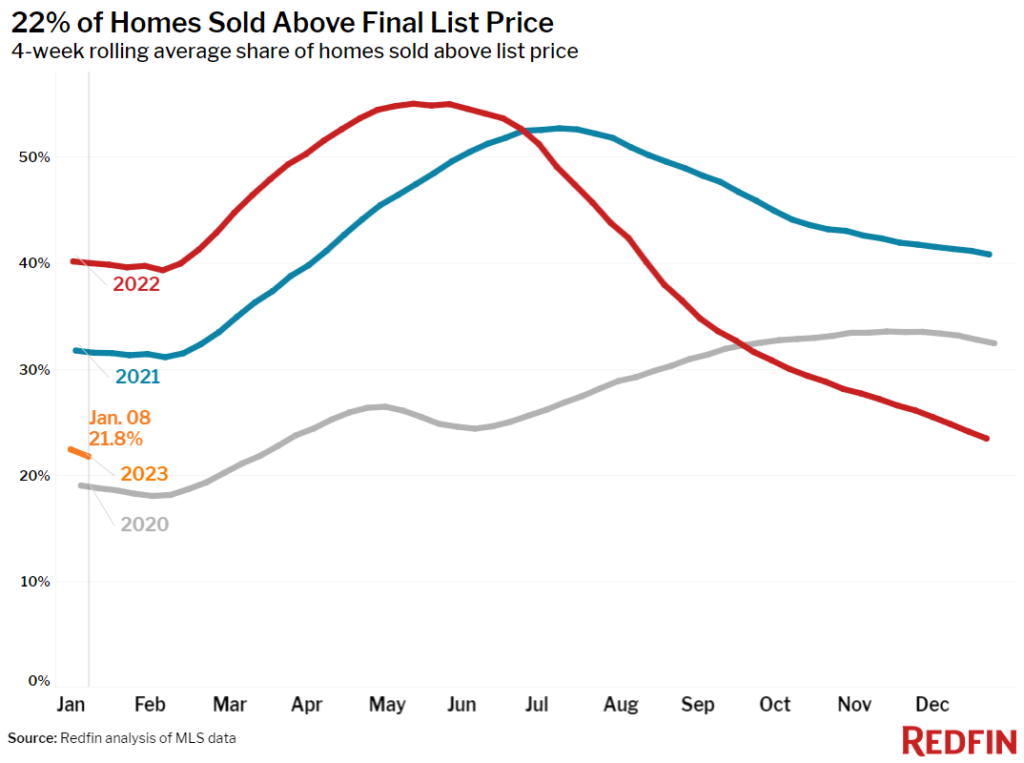
  • 22% of homes sold above their final list price, down from 40% a year earlier and the lowest level since March 2020.

  • On average, 4% of homes for sale each week had a price drop, down sharply from 5.7% a month earlier.  

  • The average sale-to-list price ratio, which measures how close homes are selling to their final asking prices, fell to 97.9% from 100.1% a year earlier. That’s the lowest level since March 2020.

Refer to our metrics definition page for explanations of all the metrics used in this report.

Source: Redfin.com

ARE YOU READY TO close your deals?

LET US HELP YOU close it BY FILLING OUT OUR FORM OR
GIVING US A CALL AT

(626) 796-1680

call it NOW!

How Long Does It Take to Build Credit History From Scratch?

If you ever plan to buy a house, establishing a track record of past payments is essential, because it proves to mortgage lenders that you’ve paid people back (which means they’ll be more apt to loan you money for a home).

Still, if you have no credit history—because you’re young or just never bothered—how long does it take to build it from scratch?

Here’s the straight dope: Done right, it can take as little as six months. Done wrong? It can take several years. So if you’re in a rush to establish credit to buy a home, you’ll want to know the right way to go about it! Heed this advice to learn what to do.

Building credit: A timeline

At a minimum, you need to open at least one credit card in your name. From there, you just need to make a purchase using the card, and then make a payment. Once you’ve made your payment, your creditor will report your payment to one or more of the major credit bureaus (TransUnion, Equifax, and Experian).

“Typically, it takes at least three to six months of activity before a credit score can be calculated,” says Tracy East, director of communication at Consumer Education Services in Raleigh, NC.

Once you’ve established credit, you still have some work to do. Credit histories are scored based on performance, much like the grades you got in school. Healthy credit behavior—like on-time payments and staying well below your credit limit—lead to a higher credit score.

What’s more, there are two types of scores: VantageScores and FICO scores. Some mortgage lenders may look at a VantageScore, but FHA lenders are required to use FICO scores.

“After opening their first credit account and beginning to make timely payments, it will take at least three months for the person to generate a VantageScore, and six months to have enough information to create a FICO score,” says Martin Lynch, compliance manager and director of education at Cambridge Credit Counseling of Agawam, MA.

And the longer you demonstrate good credit behavior, the higher your score can climb from there. In other words, a couple of on-time payments is nice, but years and years of on-time payments is far more impressive, and reflected in your score accordingly. In fact, the length of your credit history can count for as much as 15% of your credit score.

What credit score do you need to get a mortgage?

Your initial credit score when building credit will typically be in the 660s, which is considered on the low end of “fair” (fair scores range from 650 to 699). It could be just enough to buy a house with some lenders, but not all, because lenders vary regarding the minimum credit score they will accept.

You should also know that while a “fair” score may get you a mortgage, it won’t qualify you for the best mortgage—in terms of interest rates and other deals. To get better mortgage rates, you will need a good score (700 to 759) or an excellent score (760 or higher). Unfortunately, achieving these scores will take (you guessed it) more time.

How to speed up the credit-building process

To establish a payment history, use your card reasonably. Make payments on time (or early, if possible). Setting up automatic payments can help. East recommends keeping your balance below 30% of your credit limit and, ideally, paying it off in full each month. These simple steps will eventually push your score from fair to good to excellent, allowing you to get the best rates for your mortgage.

Here are some other ways to speed up the credit-building process and ensure your credit history and score get off to a good start.

  • Become an authorized user on someone else’s account. This can be a parent, friend, or relative who has had the account for at least a few years and has a good payment history. You don’t need to use the account or even have a card. Once you’re added as an authorized user and that fact is reported to the credit bureaus, it will instantly affect your credit and may generate a score if you don’t already have one or, at least, give it a boost.

  • Get a secured credit card or loan. If you’re having trouble qualifying for a traditional credit card, try for a secured credit card, which is “secured” by a deposit. This means that if you default or stop paying, your deposit will be used to pay off the account. This lowers the risk involved for the lender, which makes it more likely to offer you credit even if you don’t have an established credit history.

Also know that when it comes to mortgages, your credit score is just one piece of a larger puzzle. According to Lynch, your lender will also look at your employment history, how long you’ve lived at your current residence, and your credit references.

Source: Realtor.com



HAVE ANY SCENARIOS YOU WANT US TO LOOK AT?


Simply fill out our form or
give us a call at
(626) 796-1680


to get started!

Can You Show Your Home With an Offer on the Table?

Can you show your home with an offer on the table? Sure, you’ve found a (nearly) perfect buyer. You’ve accepted the offer, which means you’re in wedded bliss and off the market, so to speak, right? Not so fast! Just as a romantic relationship can go sour, so can your real estate transaction. No matter how perfectly matched your buyers are to your property, issues can arise that are out of your control, and sometimes the buyers’ too.

That’s why it’s in your best interest to let your real estate agent play the field and allow your home to be shown, even if you’ve accepted an offer.

Can you show your home with an offer on the table

“Until all contingencies on a contract are removed, anything can happen,” explains Jane Peters, broker and owner of Home Jane Realty in Los Angeles. “Each side has to meet certain contractual obligations, and if one side doesn’t, then the other side can initiate a cancellation of the contract,” she says.

Such contractual obligations can include both sides not agreeing on a request for repairs after an inspection, says Peters. Other times, the buyer believes there’s too much to deal with and decides not to go forward. It’s also possible that your buyer can’t get the loan approved. And if your home doesn’t appraise at the contracted price and you decide not to lower it or grant the buyer concessions, then the buyer can walk, too.

If your offer’s wrapped up in the buyers’ ability to successfully offload their own home, there’s also a chance the sale could take months—maybe even years. If that’s the case, “then you may wish to continue showing your house in hopes of getting buyers who can close in a more timely manner,” says Christy Murdock Edgar, a Realtor® in Northern Virginia and Washington, DC.

Ways to protect yourself from a stalled home sale

To cover all of your bases, consider including a “kick-out clause” in your contract. This states that although you’re currently under contract, you’re allowed to kick out the buyer for a better offer that comes along during the contract period, Edgar says. “As with any other element of the process, this can be negotiated.”

But even if you are pleased with your current offer, you might still want to let your agent continue showing your home.

“In a seller’s market, with multiple offers on many properties, there should be no shortage of backup offers waiting in the wings,” acknowledges Peters.

“Should” is the operative word there. Nothing is guaranteed, so it’s probably in your best interest to keep cleaning your home and agreeing to those weekend open houses, even if it means sending your golden retriever to day care and hauling the kids to hang out at your in-laws’ house for the entire afternoon.

“Until all contingencies have been removed during escrow, continuing to show the property is advisable,” says Peters.

Source: Realtor.com


Are you ready to take the next step in your business journey?

Let us help you succeed by filling out our form or
giving us a call at

(626) 796-1680

Take the first step now!

2023: The Year of the Homebuyer? Our Bold Predictions on Home Prices, Mortgage Rates, and More

It’s safe to say we’ve never encountered a housing market nearly as unpredictable as the one we’re in right now. After months of navigating wild fluctuations, homebuyers, sellers, owners, and renters are now desperately trying to read the tea leaves to figure out where real estate prices, inventories, sales, and mortgage rates are going in the coming year.

And just in time, Realtor.com® is here to help them all figure it out with our annual housing forecast.

The bottom line: Homebuyers and renters hoping for some financial relief in 2023 will likely be disappointed. But they won’t get whiplash either. The dramatic swings and wild gyrations in the housing market are expected to taper off as the real estate ecosystem continues to slow.

While the Realtor.com 2023 forecast anticipates home and rental prices will keep climbing next year, the increases will be much more modest than the huge surges seen earlier this year. Mortgage interest rates, which have become the bane of many first-time and other buyers who can’t pay all in cash, will remain high. But they aren’t expected to substantially rise again.

Sales are expected to continue falling as buyers simply can’t afford the onerous combination of towering home prices and high mortgage rates. Home and rental prices have been falling from their peaks over the summer, but they’re still rising year over year.

“It’s going to be a tough year for homebuyers, home sellers, and the overall housing market,” says Realtor.com Chief Economist Danielle Hale. But “we’re going to take some steps toward a better balance between buyers and sellers.”

One bright spot for buyers will be the number of homes for sale, which has been hovering near crisis level and is finally expected to rise. But will that be enough to bring buyers back into the market?

This is what homebuyers, home sellers, and renters can expect in the new year.

Source: Realtor.com


Have Any Scenarios
You Want Us To Look At?

Either fill out our
form or give us a call!

(626) 796-1680!

Mortgage Rates Dip Slightly to 6.66%, but Have Doubled From a Year Ago

The numbers: Mortgage rates took a breather from its march towards 7% this week, as the economic outlook looks uncertain.

The 30-year fixed-rate mortgage averaged 6.66% as of Oct. 6, according to data released by Freddie Mac on Thursday.

That’s down 4 basis points from the previous week—one basis point is equal to one hundredth of a percentage point, or 1% of 1%.

Last week, the 30-year was at 6.7%.

It’s worth noting that Mortgage News Daily, which follows day-to-day movement in mortgage rates, is noting that the 30-year is at 6.95%.

Though rates have come down as per Freddie Mac — albeit ever so slightly — overall, mortgage rates are still high relative to where they were a year ago.

‘Rates remain quite high compared to just one year ago, meaning housing continues to be expensive for potential home buyers.’

Sam Khater, chief economist at Freddie Mac

Last year, the 30-year was averaging at 2.99%.

“Rates remain quite high compared to just one year ago,” Sam Khater, chief economist at Freddie Mac, said in a statement, “meaning housing continues to be expensive for potential home buyers.”


This October, the average rate on the 15-year mortgage also dropped slightly to 5.9%.

The adjustable-rate mortgage, or ARM, averaged 5.36%, up from the prior week. Interest in ARMs is rising, with the share of ARMs as a percentage of all mortgage applications for purchases of a home rising to 12%, the Mortgage Bankers Association said. That’s the highest level it’s reached since 2008.

Overall, mortgage applications fell significantly in the latest week, as buyers pulled back amid higher rates, and also due to the hurricane-induced closures in Florida.

The yield on the 10-year Treasury note rose to 3.8% in morning trading on Thursday.

Source: Realtor.com

Mortgage Rates Rise for Fifth Week in a Row, Hitting 6.29%

By Charley Grant
Sep 22, 2022


Mortgage rates rose for the fifth consecutive week, reaching yet again the highest level since the financial crisis.

The average rate on a 30-year fixed mortgage climbed to 6.29%, according to a survey of lenders released Thursday by Freddie Mac. It was the second week in a row that rates topped 6%. The last time rates were this high was October 2008, when the U.S. was deep in recession.

The sharp rise is another product of the Federal Reserve’s campaign to curb decades-high inflation. On Wednesday, the central bank raised interest rates for the fifth time this year. Officials indicated that more large increases are on the way even if such moves risk a recession.

A year ago, mortgage rates were 2.88%.

Higher rates affect virtually every corner of the economy, but their effect on housing is particularly acute since higher rates can easily add hundreds of dollars to a buyer’s monthly mortgage payments.

Take a borrower who buys a $500,000 house with a 20% down payment. With a 2.88% mortgage, that person can expect to pay about $200,000 in interest over 30 years for their $400,000 loan, according to a mortgage calculator by Bankrate.com. With a 6.29% mortgage, the borrower could pay more than $490,000 in interest.

Higher rates have cooled housing significantly. Though home prices continue to notch year-over-year gains, prices are falling month-over-month. Many would-be buyers are getting priced out of homeownership. Many homeowners feel stuck in place, since selling would mean taking on a mortgage with a significantly higher rate.

The national median mortgage payment was $1,839 in August, up 33% from the start of the year, the Mortgage Bankers Association said Thursday.

Mortgage rates don’t move automatically when the Fed raises its rate. They typically rise or fall in tandem with the benchmark 10-year Treasury yield, but that yield is heavily influenced by expectations for Fed rates. The 10-year yield this week hit its highest level since 2011.

Source: Realtor.com

US Housing Prices Fall for First Time Since 2012

  • Pandemic frenzy is hitting the skids as mortgage rates climb

  • Index of 20 cities posts first monthly decline since 2012

    Say goodbye to the housing bull run. US home prices -- for the first time in a decade -- are falling.

    A national measure of prices in 20 large cities fell 0.44% in July, the first drop since March 2012, the S&P CoreLogic Case-Shiller index showed Tuesday. The last real estate crash ended in 2012, ushering in 10 years of price gains, capped off by the two-year pandemic buying frenzy.

    But the Federal Reserve has put a swift end to the party as it fights to curb inflation. Mortgage rates this year doubled, pricing out many buyers and causing sales to plunge. Now values are heading south. The biggest month-over-month declines in July were in San Francisco (-3.6%), Seattle (-2.5%) and San Diego (-2%).

    “The cooling has come hard and fast,” Stephen Stanley, chief economist at Amherst Pierpoint, said in a note.

To be sure, prices remain high. The Case-Shiller national index jumped 15.8% year-over-year in July. But that was the smallest gain since April 2021, and the slowdown from the 18.1% jump in June was the largest deceleration in the history of the index.

There are also signs that there is plenty of pent-up demand for housing. US sales of new homes surged unexpectedly in August, government data showed Tuesday.

It was the strongest pace of new-home sales since March, perhaps reflecting a race by buyers to beat further increases in borrowing costs and take advantage of price cuts by some builders. New-home sales rose in all regions, including a 29.4% jump in the South, where the pace was the firmest this year.

The declines in home prices have been steepest in the most unaffordable locations, especially on the West Coast, where buyers were already strained early this year when rates were still near historic lows.

The falloff looks extreme compared with the two-year pandemic frenzy, marked by multiple offers and a shortage of listings that drove buyers to bid high.

Now listings are lingering longer because demand has collapsed, adding to the active inventory. One thing may help to keep prices elevated: fewer homes are coming on the market.

Homeowners who don’t have to move are staying put. Buying a house for most requires giving up a cheaper mortgage. A recent report from Zillow Group Inc. showing that new listings slid almost 23% in August from a year earlier.

Meanwhile, the Federal Reserve continues to move interest rates upward, Lazzara said.

“Given the prospects for a more challenging macroeconomic environment, home prices may well continue to decelerate,” he said.

— With assistance by Chris Anstey, and Vince Golle

September 27, 2022 at 6:00 AM PDTUpdated onSeptember 27, 2022 at 8:02 AM PDT
By

Prashant Gopal

Source: Bloomberg.com

Rodolfo Campos and Diego Corona Affordable Homeownership Interns 2019 .

Interns1-01-01.png

What interested you most about an Internship at Capital Direct Funding?

Rodolfo Campos:

Taking on challenges is something that I have embraced my entire life, no matter how difficult the situation may be, as a result, I decided to attend UC Berkeley. My immediate post-graduation goal is to help underrepresented communities, especially East LA, by supplying family’s and students with the necessary resources to successfully embark on their journey. I firmly believe that sharing knowledge, experiences, and skills are essential for us to grow as a community. This internship is giving me the critical thinking abilities necessary to carry out my goal, as well as helping me quench my insatiable desire to learn more about financial literacy, investments, and savings. Capital Direct Funding is helping me build my future brick by brick.

Diego Corona:

As I transitioned from high school to college, my passion for financial literacy grew and so did my efforts to try to assist the underdeveloped and low-income communities. As a first-generation Latino, I witnessed family and friends be affected by housing and financial crises and I made it my goal to help these families stabilize their future. After completing my freshman year at UC Berkeley, I wanted to learn more about Real Estate and investments to further understand how the markets work and eventually gain enough knowledge to assist the families in need. As an intern at Capital Direct Funding, I was able to work alongside a sharp group of individuals who cared for the well being of the community and I was able to expand my apprehension of the housing market as I learned more about real estate investments and loan programs.


Give us one take away from your experience working at Capital Direct Funding?

Rodolfo Campos:

My greatest takeaway was financial literacy. Although one may learn some of it in college, it is different to experience it and see it applied in a professional setting.

Diego Corona:

I really enjoyed having conversations with Frank, Sandra, Francisco and the entire staff at Capital Direct Funding. Their perspectives and professionalism really helped me become more curious in financial services and has contributed to the growth of my passions.


What are some of your hobbies?

Rodolfo Campos:

As a Los Angeles Marathon two-time finisher, I have avidly enjoyed running since I was 12. However, other interests lie in playing guitar, drawing, basketball, and lifting weights.

Diego Corona:

As a musician with Mariachi Vilazul, I enjoy playing the trumpet and performing for festivities. I also enjoy playing basketball and having insightful conversations with my peers and coworkers.


Who is your Inspiration?

Rodolfo Campos:

Talking to my parents gave me a window into their life beyond their listless fatigue that seemed to follow them the moment they enter the door, eyes dry and bloodshot, yet the moment they meet mine, I am happily met with a smile. Tough hands and rugged feet are the norm, and as a result of witnessing their hard work, they became my inspiration to be better. I can never repay my parents’ sacrifices with material possessions, but rather by demonstrating that their hard work bore fruit and making something of my life.

Diego Corona:

My parents and family are my biggest inspiration. All their sacrifice and experiences have helped shape me into who I am today, and it is my goal to repay them by taking advantage of any opportunity offered to me and by becoming the best version of myself that I can be.


What skills did you develop?

Rodolfo Campos:

I am learning how to think ahead. Although focusing on the present is important, it is also important to think of what your next step will be, and how it will benefit the cause you are trying to create. Furthermore, I have developed managerial and budgeting skills that are both basic and important tools in life.

Diego Corona:

During my internship I further developed my ability to think out of the box by sitting in with conversations with Frank, Sandra, and Francisco.


What app can you not live without and why?

Rodolfo Campos:

I cannot live without Reddit, it’s my main source for news, answers, and memes.

Diego Corona:

I can’t live without Google because it’s the gateway for answers and creates a new path for questions to be asked.


What Character trait do you want to be known for?

Rodolfo Campos:

Grit is all I can ever refer myself to. From working hard and getting into Berkeley, to receiving scholarships to attend, to completing the LA Marathon. It was not easy, but everything that is worth doing will never be. Although adversity can be crushing, you will become a better person in the end.

Diego Corona:

I want to be known for my strong work ethic, dedication, and for delivering the best results to the best of my abilities.

Want to Grow? Join me March 14th!! NAHREP LA San Gabriel Valley Event. Real Estate, Build Your Future.

Sandra Williams is President and Co-Founder of Capital Direct Funding in West Covina, California and now Marketing Director for NAHREP San Gabriel Valley. She has been a supporter of NAHREP ever since Frank Williams, Co-Founder and Director of Divisional Sales & Operations at Capital Direct Funding, in 2015.


As true Agents of Change, Sandra works side by side with Angel Virgen, a Representative of Skyline Security 10X. They both showcase the Values what NAHREP San Gabriel Valley Chapter has to offer. On March 14th, there will be several Elite Panelists speaking on opportunities they obtained with strategic viewpoints and will share their knowledge to give you a edge on the Future of Real Estate!


“An investment in knowledge pays the best interest. There are no secrets to success. It is the result of hard work, preparation, and learning from those who have already done what you are set out to do” Says Angel Virgen. Investing in yourself is a great direction to set yourself up for a successful 2019! March 14th at The Sheraton Fairplex Conference Center, save the date!


National Mortgage Professional : Featured Industry Leader

National Mortgage Professional : Featured Industry Leader

Frank Williams is Co-Founder and Divisional Manager of Capital Direct Funding Inc. in West Covina, Calif.,and President of the Los Angeles Metro Chapter of the California Association of Mortgage Professionals (CAMP). National Mortgage Professional Magazine recently spoke with Williams regarding his work with CAMP and his local Chapter.

CDF Easter Blessings 2018

CDF Easter Blessings 2018

In 2017 Capital Direct Funding began the Easter Blessings Campaign. This thoughtful project came about through Frank Williams, Divisional Manager of CDF. Frank holds a dear childhood memory of his mother receiving a dinner from their church one Easter Sunday. Being a lower income family this held a significant appreciation and gratitude from him and his family. Even though this practice is most common during Christmas and New Year’s we understand how important Easter is to many of us and we believe it should be commemorated equally.


Relieve stress and increase productivity through exercise with Sandra Williams

Relieve stress and increase productivity through exercise with Sandra Williams

“Where we put our time reflects our deepest values” states Sandra Williams, Co-founder and President of Capital Direct Funding. The key to balancing your life, your career, family, relationships, and self-care is dependent on self-discipline. Although incorporating physical training into her busy schedule was challenging at first, she was convinced she wanted it, and so she went for it! With some inspiration from her colleagues, who make time to workout despite their plentiful responsibilities, she was prompted to take on a new challenge.

2018 Gubernatorial Forum Candidates

2018 Gubernatorial Forum Candidates

A year ago I  was asked to serve as the Los Angeles Chair of an organization called THE 200 led by Joe Coto former California State Assemblyman and John Gamboa President of California Community Builders and former director of The Greenlining Institute .   As an advocate of sustainable Homeownership for more than 25 years, I am a firm believer in creating wealth through Homeownership, and building an intergenerational legacy.